Writing a custom datatype
This page is for application creators who need a field type the shipped datatypes do not offer: a color, a rating, a
structured address. A datatype is a class extending eZDataType (kernel/classes/ezdatatype.php) plus a view and an
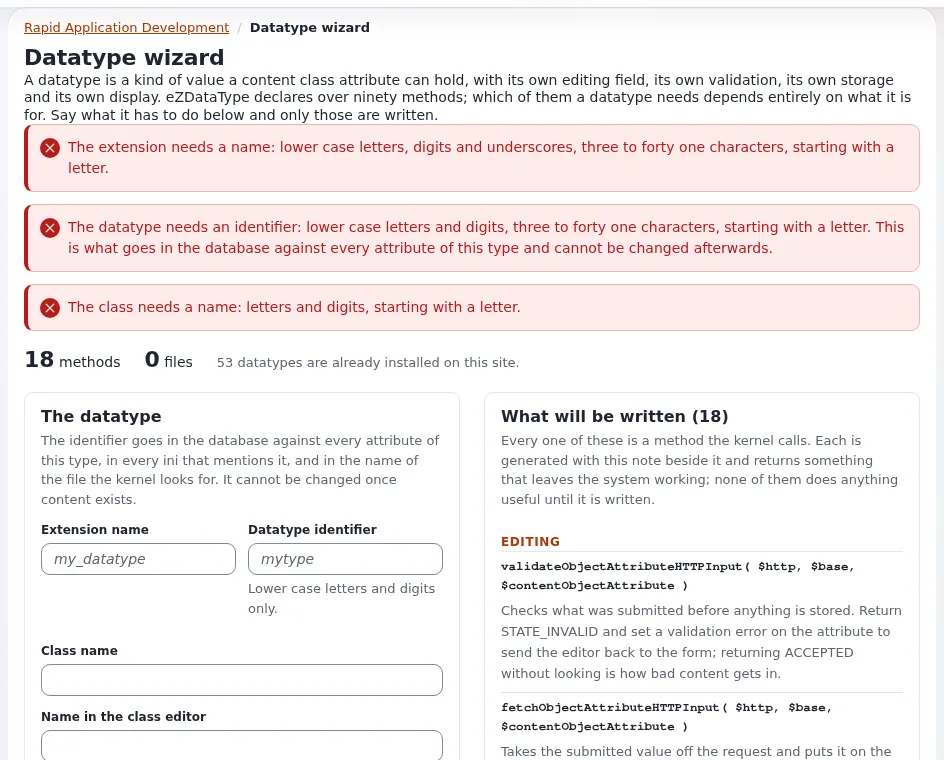
edit template. Setup > RAD > Datatype extension (/setup/datatype) writes a working skeleton
(RAD tools).
Contents
Check first
Many needs are met by a shipped datatype or an extension (Choosing datatypes). A datatype is a long-lived commitment: content stored with it depends on your extension forever.
Files and registration
extension/expdemo/datatypes/expcolor/expcolortype.php
extension/expdemo/design/standard/templates/content/datatype/view/expcolor.tpl
extension/expdemo/design/standard/templates/content/datatype/edit/expcolor.tpl
extension/expdemo/settings/content.ini.append.php
[DataTypeSettings]
ExtensionDirectories[]=expdemo
AvailableDataTypes[]=expcolor
*/ ?>This is how the shipped ezstarrating registers its datatype (extension/ezstarrating/settings/content.ini.append.php).
The class
class expColorType extends eZDataType
{
const DATA_TYPE_STRING = 'expcolor';
public function __construct()
{
parent::__construct( self::DATA_TYPE_STRING, ezpI18n::tr( 'extension/expdemo', 'Color' ),
array( 'serialize_supported' => true ) );
}
function validateObjectAttributeHTTPInput( $http, $base, $objectAttribute )
{
$name = $base . '_expcolor_' . $objectAttribute->attribute( 'id' );
$value = $http->hasPostVariable( $name ) ? trim( (string)$http->postVariable( $name ) ) : '';
if ( $value === '' && $objectAttribute->validateIsRequired() )
{
$objectAttribute->setValidationError( ezpI18n::tr( 'extension/expdemo', 'Choose a color.' ) );
return eZInputValidator::STATE_INVALID;
}
if ( $value !== '' && !preg_match( '/^#[0-9a-f]{6}$/i', $value ) )
{
$objectAttribute->setValidationError( ezpI18n::tr( 'extension/expdemo', 'Write the color as #rrggbb.' ) );
return eZInputValidator::STATE_INVALID;
}
return eZInputValidator::STATE_ACCEPTED;
}
function fetchObjectAttributeHTTPInput( $http, $base, $objectAttribute )
{
$name = $base . '_expcolor_' . $objectAttribute->attribute( 'id' );
if ( !$http->hasPostVariable( $name ) )
return false;
$objectAttribute->setAttribute( 'data_text', strtolower( trim( (string)$http->postVariable( $name ) ) ) );
return true;
}
function objectAttributeContent( $objectAttribute )
{
return $objectAttribute->attribute( 'data_text' );
}
function hasObjectAttributeContent( $contentObjectAttribute )
{
return $contentObjectAttribute->attribute( 'data_text' ) !== '';
}
function metaData( $contentObjectAttribute )
{
return $contentObjectAttribute->attribute( 'data_text' );
}
function toString( $objectAttribute )
{
return (string)$objectAttribute->attribute( 'data_text' );
}
function fromString( $objectAttribute, $string )
{
$objectAttribute->setAttribute( 'data_text', (string)$string );
return true;
}
function title( $objectAttribute, $name = null )
{
return $objectAttribute->attribute( 'data_text' );
}
function isIndexable()
{
return true;
}
}
eZDataType::register( expColorType::DATA_TYPE_STRING, 'expColorType' );The method names and signatures are those of eZDataType; the registration line at the end is how every shipped
datatype registers itself (for example kernel/classes/datatypes/ezboolean/ezbooleantype.php).
Templates
content/datatype/edit/expcolor.tpl:
<input type="color" id="ezcoa-{$attribute.contentclassattribute_id}_{$attribute.contentclass_attribute_identifier}"
name="{$attribute_base}_expcolor_{$attribute.id}" value="{$attribute.content|wash}">content/datatype/view/expcolor.tpl:
<span class="expdemo-color" data-color="{$attribute.content|wash}">{$attribute.content|wash}</span>No style="" in templates: a stylesheet or script reads data-color
(Content Security Policy for your code).
Storage
Each attribute version has columns data_text, data_int, data_float (and the class attribute has data_text1...,
data_int1... for settings). Store simple values there; complex ones in your own table keyed by attribute ID and
version, cleaned up in deleteStoredObjectAttribute() (The datatype life cycle).
Testing it
- Regenerate autoloads, clear caches.
- Add an attribute of the new type to a test class; create, edit, translate, copy and remove objects.
toString()/fromString()round-trip in a PHPUnit test (DB-less PHPUnit tests).- Package export and import keep the value (Content packages).
Related pages
- The datatype life cycle
- Datatype pattern
- Extension points: Datatype
- Free documentation: this page is free to copy, translate and improve under the GNU FDL 1.3.
Become an Exponential Partner
Partners share their information, provide funding, contribute back and develop the products with us, and that is how Exponential grows. A partner website and dashboard are planned for mid-2027: please become a partner today to speed up our growth rate and land new features faster.