Queues with expqueue
This page is for application creators whose application has work that must not happen in a web request: calls to slow
services, bulk updates, sending, AI requests. expqueue is a database-backed job queue: producers enqueue a job with one
call; workers run it on the command line (expqueue). Its full
documentation is in extension/expqueue/doc/ (api.md, scheduling.md, workers-cron-systemd.md).
Contents
Switching it on
Activate it globally:
[ExtensionSettings] ActiveExtensions[]=expqueueinsettings/override/site.ini.append.php.Create the tables (idempotent):
./console ext:expqueue:install-schema.Regenerate autoloads and deploy.
A worker every minute:
* * * * * cd /path/to/installation && php runcronjobs.php -q expqueue >> var/log/cronjob-expqueue.log 2>&1Check:
./console ext:expqueue:enqueue expqueue.noop,./console ext:expqueue:work --once,./console ext:expqueue:status.
Enqueueing a job
$job = expQueue::enqueue( 'expdemo.archive', array( 'object_id' => $objectID ), array(
    'idempotency_key' => "archive:$objectID:$version",
    'priority' => 50 ) );
Options include class (priority class), priority, group, idempotency_key, resource (a concurrency key),
not_before, max_attempts, timeout, depends_on, user_id. The payload is stored as JSON and shown in the admin:
never put a secret in it; pass IDs and let the handler read credentials from settings.
Writing a handler
Register the type:
# extension/expdemo/settings/expqueue.ini.append.php
[JobType_expdemo.archive]
Handler=expDemoArchiveHandler
MaxAttempts=4
Timeout=300
Description=Sends one published object to the archive
Implement expQueueHandler::run( expQueueJob $job, expQueueContext $context ) or extend expQueueHandlerBase
(which adds validate() at enqueue and describe() for the admin). run() returns nothing or an array (done), or an
expQueueResult: done(), retry( $message, $retryAfter ), fail(), defer(), hold(), cancelled(). Other
exceptions count as retryable.
class expDemoArchiveHandler extends expQueueHandlerBase
{
    public function run( expQueueJob $job, expQueueContext $context )
    {
        $payload = $context->payload();
        $object = eZContentObject::fetch( (int)$payload['object_id'] );
        if ( !$object )
            return expQueueResult::fail( 'The object is gone' );
        expDemoArchiveClient::send( $object );
        return array( 'sent' => true );
    }
}
Workers
Workers run from cron (runcronjobs.php expqueue) or as a systemd service (./console ext:expqueue:service install) for
shorter waits, never inside a web request. If your job types are active only in some siteaccesses, give the worker
-s <siteaccess>.
Watching and controlling
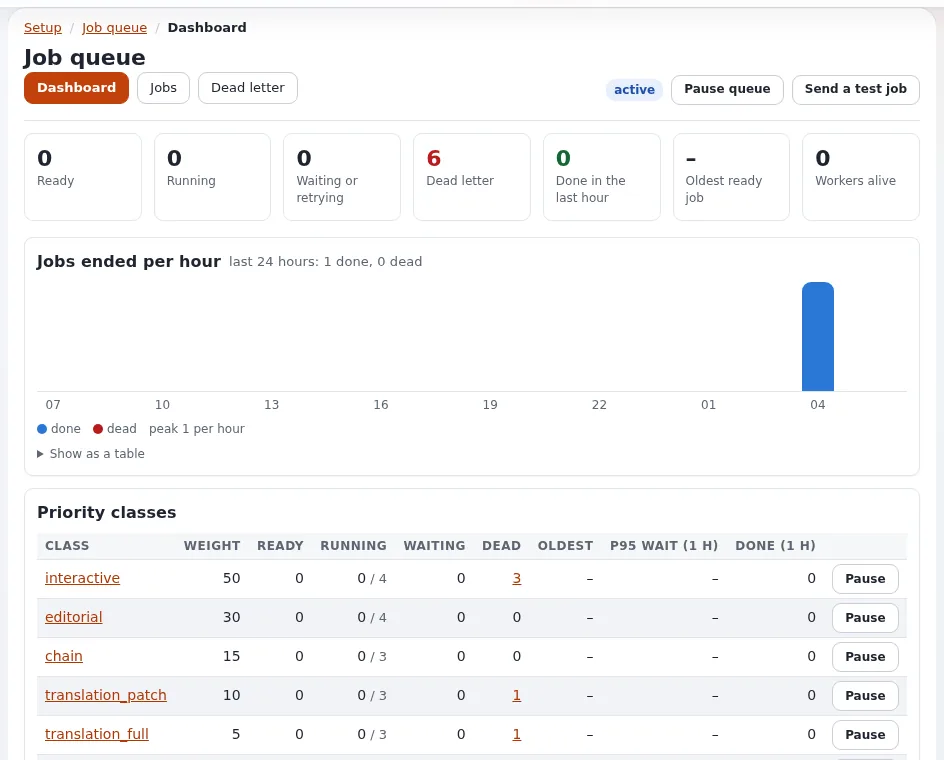
Setup > Job queue shows the dashboard, jobs, groups and controls; policies expqueue/view and expqueue/manage.
Jobs can be cancelled, retried, paused per queue, class, resource or group.
Rules for handlers
- Idempotent: a job can run again after a crash or a retry; use the checkpoint for steps that cost money.
- No database transaction around a slow call.
progress()orheartbeat()at least every half timeout in long work.- The job runs as the user who queued it; check permissions as that user.
Related pages
- Background work: queues, cronjobs and content jobs
- Content jobs
- Exponential Intelligence for applications
- Free documentation: this page is free to copy, translate and improve under the GNU FDL 1.3.
Become an Exponential Partner
Partners share their information, provide funding, contribute back and develop the products with us, and that is how Exponential grows. A partner website and dashboard are planned for mid-2027: please become a partner today to speed up our growth rate and land new features faster.