Hosting companies: start here
This section of the help is for hosting companies and service providers that host Exponential sites for their customers, or want to: product managers who design an "Exponential hosting" offer, system administrators who build and run the servers, support staff who answer customers, and the people who market the offer. It answers: what an Exponential site needs from a server, which hosting models and server stacks fit, how to install, update, back up, monitor and secure customer sites, and how to package all of that as a product.
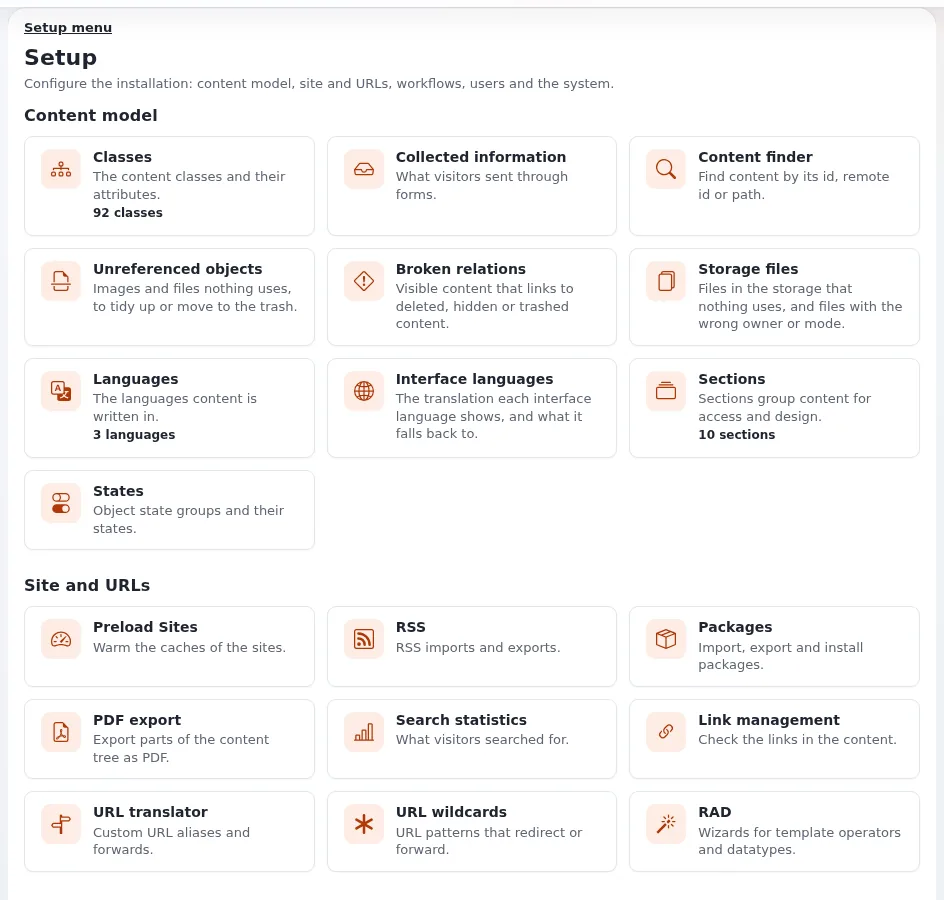
Every command and setting in this section was checked against the source code and the installation book of this release. Where the sources give no figure (prices, response times, capacity per server), the pages give none either: they show you how to measure and decide.
Contents
- Exponential in one minute, for hosts
- What a server must provide
- How this section is organized
- Your first week
- Reading paths by role
- The pages you will use most
- Where to get help
Exponential in one minute, for hosts
- It is a PHP application. Exponential is "a professional PHP application framework with advanced CMS (content
management system) functionality" (
README.md). It runs on PHP 8.0 to 8.5 (PHP 7.4 usable without support), on almost any operating system that runs PHP 8 (Operating system support). - It is free software. The code is licensed under the GPL v2 or later and costs nothing; you can install it for any number of customers. The documentation, including this page, is under the GNU FDL 1.3 (Free documentation).
- It has a long history. Exponential continues the code base of eZ Publish, a product its creator discontinued after almost 18 years; 7x and the Exponential Foundation maintain it today (Who is 7x?, Who is the Exponential Foundation?).
- It needs a database, a web server or engine, and writable storage. That is the whole footprint; there is no separate application server to license.
- It brings its own engine. Exponential Velocity is a persistent-worker web server written in PHP, recommended for every stage; FrankenPHP is a production-ready alternative; Apache or nginx with PHP-FPM remain fully supported and are what shared hosting usually offers (Chapter 8).
- As of 6.0.15 that engine is part of Exponential. The root
composer.jsonrequiresse7enxweb/exponential-velocity ~0.0.4.57(throughse7enxweb/exponential-php-floor, on PHP 8.0 and later), so every site you install with Composer has the Velocity Internet / Web Application Server, on the same PHP as the site (8.0 and later, the stock PHP 8.0 of Red Hat Enterprise Linux 9 included). It needs thesocketsextension, withpcntlandopensslrecommended. Nothing switches engines on its own, so an Apache or nginx offer keeps working unchanged; offering Velocity is a setting ([ServerSettings] Engine=qbix) and a long-running process, not a second product to install. - One stack for your customers. With the server in the core, Exponential is one working unit: a rapid
application development stack, a CMS, digital experience features and e-commerce from one installation, one console
(
./console exp:velocity deploy,start,restart,cache clear) and one set of documentation. For a host that means fewer moving parts to support per site. The story: Velocity is part of Exponential 6.0.15.
What a server must provide
| Need | Minimum | Notes |
|---|---|---|
| PHP | 8.0 (Velocity included) | the newest 8.x your system offers; 8.5 is supported |
| Database | one of the six | in the official order: 1. SQLite 3 (default) · 2. PostgreSQL · 3. MongoDB · 4. MariaDB · 5. Oracle · 6. MySQL. Microsoft SQL Server is known to be possible with additional work at this time. |
php.ini | memory_limit 64M, max_execution_time 30, date.timezone set, file_uploads on | checked by the setup wizard |
| Web server | none required | Velocity serves HTTP and HTTPS itself; or Apache/nginx with PHP-FPM |
| Composer | 2.x | for installs and updates from source |
| Image conversion | GD or ImageMagick | both recommended |
| Writable directories | var/ (cache, log, storage, autoload) and the settings/ directories the setup writes | the setup wizard's directory_permissions check lists them; details in Writable directories and permissions |
Sources: Chapter 2: Requirements, Database support. The full picture is on Requirements at a glance.
How this section is organized
| Section | What it covers |
|---|---|
| Hosting basics | requirements, PHP, the six databases in order, operating systems, Composer and Git, permissions, sizing, media, search |
| Hosting models | shared, VPS, dedicated, containers, Kubernetes, platform as a service, managed hosting |
| Control panels | Plesk (what the project's own development server runs), cPanel, DirectAdmin, ISPConfig, Webmin; PHP pools, cron, databases, certificates |
| Web servers and engines | Apache, nginx, Caddy, LiteSpeed, IIS, Exponential Velocity, FrankenPHP |
| Performance | PHP-FPM tuning, OPcache, the caching layers, Velocity's response cache, HTTP caching, reverse proxies, CDN, Valkey, static cache, benchmarking |
| Operations | storage and clustering, backups and restore, monitoring and logs, cron jobs, mail, updates with ezupdate, deploying, maintenance mode |
| Security | hardening, TLS, Content Security Policy, request-shield, admin access, two-factor sign-in, audit trail, multi-tenant isolation, compliance |
| Provisioning | one-click installers: exp:install, the kickstarter, the setup wizard; site packages; automation; multisite |
| The hosting business | plans, SLA and support options, billing options, marketing, partner programs, licensing |
| Migrating customers | bringing customer sites to your hosting, from older versions and other platforms |
| Checklists | new server, go-live, monthly operations, security review, offboarding |
| Runbooks | site down, slow site, disk full, restore, compromised site, PHP upgrade, certificate expiry, Velocity will not start |
| Glossary for hosts | the terms used in this section |
Your first week
A plan for a team that is about to add Exponential to its offer.
| Day | Do | Read |
|---|---|---|
| 1 | Decide which hosting model and stack your first offer uses | Choosing a hosting model, Choosing a web server |
| 2 | Build one test server from the checklist; install a site with exp:install | New server checklist, One-click installers |
| 3 | Harden it and put the logs where your monitoring can read them | Hardening for hosts, Monitoring overview |
| 4 | Back it up, then restore it on a second machine | What to back up, Restore and restore tests |
| 5 | Measure it, write down the limits of a plan, and draft the offer | Benchmarking a hosted site, Designing hosting plans |
Tip
Do day 4 for real. A backup that has never been restored is a hope, not a backup; the installation book's first-week checklist asks for a backup "taken and restored on another machine" (10.15).
Reading paths by role
- Product manager at the host: this page, Choosing a hosting model, Designing hosting plans, SLA options, Support tiers, Marketing Exponential hosting.
- System administrator: Requirements at a glance, Databases in the official order, Velocity for hosts, PHP-FPM tuning, Caching layers, Multi-tenant isolation, the checklists and runbooks.
- Support staff: Monitoring overview, Log viewer and rotation, Site down, Slow site, When something goes wrong.
- Migration team: Migrating customers to your hosting and the installation book's chapters 14 to 17.
The pages you will use most
- Requirements at a glance
- Databases in the official order
- Choosing a hosting model
- Choosing a web server
- Velocity for hosts
- Caching layers
- What to back up
- Hardening for hosts
- Multi-tenant isolation
- One-click installers
- Go-live checklist for a customer site
Where to get help
- This help. Search it from the box at the top of the help dashboard; filter by the Hosting audience.
- Bugs and security issues. Report a software bug as described on When something goes wrong;
report a security problem privately, as
SECURITY.mdin the repository describes, never in a public issue (Security updates and disclosure). - The project and its maintainers. 7x and the Exponential Foundation are introduced on Who is 7x? and Who is the Exponential Foundation?; how hosts work with them is on Working with the project and 7x.
- Other hosts and partners. The Partners section of this help describes the partner programs; the community places are listed on Who is the Exponential Foundation?.
Public demos. Hosting a public demo of Exponential, with a published administrator sign-in? Run it in demo mode (EXP_DEMO_MODE=1 for that site only): Demo mode for hosts, Recipe: run a public demo on LiteSpeed and Plesk, Demo mode problems.
Related pages
- Choosing hosting, database and operating system (for project managers)
- Database support
- Operating system support
- Security hardening
- The installation book
- Migrations on hosted sites, Migrations
- Free documentation: this page is free to copy, translate and improve under the GNU FDL 1.3.
See also: Resellers, Bundlers, Database Administrators.
Become an Exponential Partner
Partners share their information, provide funding, contribute back and develop the products with us, and that is how Exponential grows. A partner website and dashboard are planned for mid-2027: please become a partner today to speed up our growth rate and land new features faster.