URL wildcards and custom aliases
This page is for website creators who need addresses the content tree does not make by itself: short campaign
addresses, friendly addresses for module pages (/login), and patterns that send a whole family of old addresses to
new ones. Reference: Links, URL aliases, wildcards and search statistics.
Contents
- Three kinds of addresses
- Global URL aliases
- URL wildcards
- Redirect or direct
- Order of resolution
- Examples
Three kinds of addresses
| Kind | Made where | Example |
|---|---|---|
| Node alias | automatically, and on the node's URL aliases tab | /About-us |
| Global alias | Setup > URL translator (/content/urltranslator) | login for user/login |
| Wildcard | Setup > URL wildcards (/content/urlwildcards) | news/* to articles/{1} |
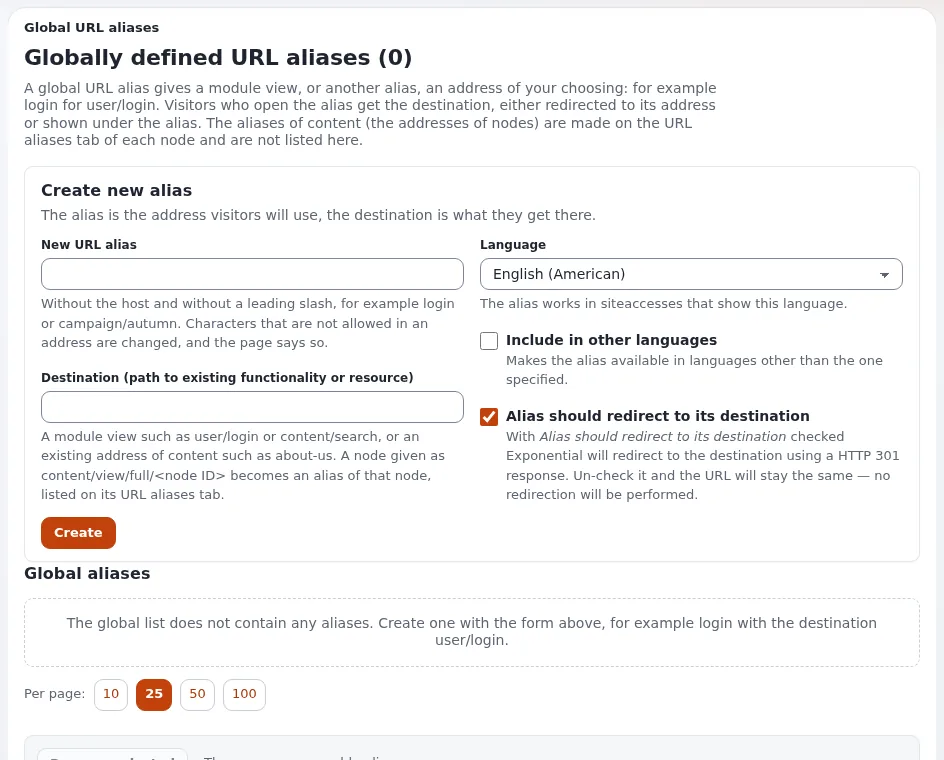
Global URL aliases
Fields: New URL alias (without host and leading slash), Destination (a module view such as user/login or an
existing address), Language, Include in other languages, and Alias should redirect to its destination.
An alias to content/view/full/<node> becomes an alias of that node and appears on the node's tab instead. The list
marks aliases whose module no longer exists.
URL wildcards
Each * in the pattern matches any text; {1}, {2} in the destination put it back. The page refuses a destination
that uses a placeholder the pattern has no * for. Try an address shows which wildcard an address matches, what it
becomes and whether visitors are redirected, without changing anything.

| Pattern | Destination | news/2026/october becomes |
|---|---|---|
news/* | articles/{1} | articles/2026/october |
news/*/* | archive/{2}/{1} | archive/october/2026 |
old-blog/* | https://blog.example.org/{1} | a redirect to the other site |
Redirect or direct
| Redirect (301) | Direct | |
|---|---|---|
| Visitor sees | the destination's address | the address they typed |
| Search engines | index the destination | may index both |
| Use for | old addresses, short campaign addresses | friendly addresses for module views |
Prefer redirect: one address per page is better for search engines.
Order of resolution
- URL aliases (node and global) first.
- Wildcards only when no alias matches, in the order they were created; the first match wins.
- Otherwise the module view itself (
/content/view/...), else "not found".
A wildcard that "does nothing" is usually shadowed by an alias or an older wildcard.
Examples
- Print campaign:
autumnredirects to/Campaigns/Autumn-2026. - Sign-in:
logintouser/login, direct. - Old site:
products/*.htmlcannot be expressed literally;products/*toProducts/{1}with the old.htmladdresses handled as aliases on the nodes that differ.
To create many global URL aliases and wildcards at once from a file (CSV, Excel, or the old site's Apache or nginx rules), import a URL map: Migrating URLs.
Related pages
- Migrating URLs
- Redirects and moved content
- URL aliases and nice URLs
- Settings page
- Free documentation: this page is free to copy, translate and improve under the GNU FDL 1.3.
Become an Exponential Partner
Partners share their information, provide funding, contribute back and develop the products with us, and that is how Exponential grows. A partner website and dashboard are planned for mid-2027: please become a partner today to speed up our growth rate and land new features faster.